A conversation

The Talk

Grahame Blackwell in conversation — exploring the origins of Quantum Relativity, the twelve themes, and why the standard account of relativity may be a brilliant description of the wrong explanation.

Orion Nebula · NASA/ESA Hubble · Public Domain

Take the talk
further.

The full paper

Scholarly article with all twelve themes, supporting evidence, and the significance for physics.

Slide deck — standard

33-slide presentation covering all twelve themes with the accepted theory and QR explanation side by side.

Slide deck — Q&A format

38-slide version structured as interview questions and key-point answers, ideal for a talk with audience.

Q & A

Origins
Q

So Grahame — what first got you interested in time and the nature of reality?

GB
  • Walking on Dartmoor — streams, rocks, seasons, the buzzards overhead — gave me a strong sense that time is something flowing through things, not a dimension we move along.
  • I started calling this "tau flux" — an energetic flow that causes change, ageing, growth.
  • Relativity says time is a dimension like space, and we move through it. I kept asking: how does moving in a direction cause ageing?
  • Watching snowdrops being washed away by a stream — and returning next year to find new plantations where none had been — time had acted constructively. That felt more real than a geometric dimension.
Q

What was happening in your work at the time that fed into this?

GB
  • I was leading a group in a 12-partner EU project developing 3G mobile technology — working deeply with electromagnetic energy, signal processing, Maxwell's equations.
  • I noticed things in EM that nobody fully explains — even though we use it very effectively. The collapse of the wave function: a signal spreads across space, then lands at one point only. Something distributes itself and then focuses completely.
  • That nagged at me alongside the tau flux idea. Both were pointing at the same thing.
Q

When did those two threads come together?

GB
  • It clicked: the tau flux I'd been thinking about isn't something mysterious — it's electromagnetic energy. Light.
  • The flow that causes ageing, growth, change — it's the flow of EM energy through matter.
  • And if time is EM energy flowing through things, then matter itself must be made of that energy.
  • Everything is made of light. That single idea opens everything else.
The foundation
Q

Is there actual experimental evidence that matter is made of light — or is this theoretical?

GB
  • Breit and Wheeler proposed it theoretically in 1934 — that slamming photons together could create matter. Stanford confirmed it experimentally in 1997.
  • RHIC at Brookhaven (2021): physically smashed photons together and produced matter. Matter from light, confirmed in the laboratory.
  • Schrödinger identified "Zitterbewegung" — jittery internal motion inside electrons at the speed of light. French physicists confirmed it experimentally in 2010.
  • The evidence was already there. It just hadn't been connected to the equations of relativity.
Special Relativity — the themes
Q

How does this change how we understand time dilation — clocks running slow when things move fast?

GB
  • Standard relativity says time slows because of spacetime geometry. No physical process is described.
  • In Quantum Relativity: EM energy circulates inside every particle at speed c. When the particle moves forward, that energy travels along and around simultaneously — a spiral.
  • Speed is fixed at c. Forward motion means fewer complete circuits per second.
  • Fewer circuits = slower internal processes = slower ageing. The Lorentz formula drops out exactly — same numbers, real mechanism.
Q

What about the speed of light being constant — why can't you catch up with light?

GB
  • Relativity simply declares it a postulate. "That's how the universe is." No reason given.
  • I'm not sure that's categorically different from just invoking God for anything one cannot explain.
  • In Quantum Relativity: matter is made of light. Your ruler, clock, eyes — all made of EM energy. When you measure light speed, your instruments are made of the very thing being measured.
  • Motion alters your instruments in precisely the same way it alters light — because they are the same thing. Invariance is self-referential and inevitable.
Q

How does this relate to E = mc² — the most famous equation in physics?

GB
  • If you've got a particle of matter made of light going round and round it, and you make that particle move — the energy that's causing the particle must now flow round and along at the same time. A spiral.
  • It's still going at speed c. But now it's going along as well as around — two jobs, one energy budget.
  • As speed rises, more energy goes to structural maintenance. Near c, almost all energy goes to holding the particle together — almost none to further acceleration.
  • E = mc² falls out of the equations naturally. No separate derivation needed. The speed limit is structural, not geometric.
Q

Relativity says two observers can disagree about the order of events — and both be correct. Is that really true?

GB
  • Relativity says they are both right — reality is multi-valued. And there are consequences: all theories of gravity must satisfy Lorentz invariance. That severely restricts what models are even allowed.
  • In Quantum Relativity: a moving observer's instruments are made of EM energy — motion physically alters them. They measure differently because the instruments are in different states, not because reality changed.
  • The train has one real length. Events have one real order. Reality is single-valued.
  • And the Lorentz invariance constraint on gravity theories is lifted. New theoretical territory opens up.
General Relativity — the themes
Q

John Wheeler said: "Matter tells space how to curve, and curved space tells matter how to move." What's missing from that description?

GB
  • Wheeler's line describes the relationship perfectly. It explains none of it. How does matter cause curvature? How does curvature move matter? What does "curved spacetime" physically mean? What extra dimension does it curve into?
  • In Quantum Relativity: every particle's EM field extends infinitely. The combined fields of all particles in a massive object create a texture of space — a field-density gradient.
  • Objects moving through this gradient are deflected by it. That produces every gravitational effect we observe.
  • No extra dimensions. No abstract geometry. Published and peer-reviewed in my 2011 paper. The maths all works out.
Q

Eddington's 1919 eclipse showed starlight bending around the Sun at exactly twice Newton's prediction. Why double?

GB
  • Newton modelled gravity as a force on mass. He missed the EM-on-EM interaction between the photon and the field texture of space.
  • A photon is EM energy. The region near the Sun is pervaded by the Sun's EM field texture. An EM wave propagating through a non-uniform EM field is deflected by the gradient — a direct physical interaction.
  • Newton had one interaction. Quantum Relativity has two. That's why Einstein is exactly twice Newton.
  • Physical. Structural. No curved spacetime required.
Why it matters
Q

If Einstein's equations give the right answers, does it matter which explanation we use?

GB
  • The key point: relativity asserts that all sorts of things are so, and points to evidence — but signally fails to offer any causal mechanism, beyond the catch-all that "this is how the universe operates. Get used to it."
  • I'm not sure that's different from invoking God for anything one cannot explain.
  • Quantum mechanics and general relativity have been incompatible for nearly a century. Unification has failed. Quantum Relativity places both within one substrate — EM energy. The incompatibility dissolves.
  • If relativistic constraints are observer effects rather than cosmic laws, whole new theoretical territory opens up.
Q

Why hasn't this been more widely taken up by the scientific community?

GB
  • Special relativity is over a century old. Careers, textbooks, billion-dollar machines are built on Einstein's interpretation. The incentive structure of science doesn't reward reopening foundations.
  • To be absolutely fair: most people who question relativity haven't understood it properly. So papers get filed as crackpottery before being read.
  • My work doesn't challenge any measurement. It offers a different physical interpretation of the same results. That's a harder case to make — and a harder one to evaluate quickly.
  • Relativity was established before quantum mechanics. The insight that matter is wavelike arrived after the interpretation had solidified. The framework was set before the most relevant evidence existed.
Q

Is there a precedent for a consensus being wrong about what's physically possible?

GB
  • Roger Bannister and the four-minute mile. For decades, physiologists concluded on reasonable evidence that no human could run a mile in under four minutes. When Bannister broke it in 1954, others followed within months.
  • The barrier was a consensus built on incomplete assumptions — not a physical limit.
  • The most important thing a theory can sometimes do is remove a prohibition that was never actually warranted.
  • Quantum entanglement correlates particles seemingly faster than light — the 2022 Nobel Prize confirmed it. If relativistic speed limits are observer effects, not cosmic laws, that changes what physics is allowed to ask next.
Closing thoughts
Q

How does consciousness fit into all this?

GB
  • We are products of an evolutionary process — from the Big Bang, through stars, planets, life. We have been constructed by some process, whether by random chance or some higher form of intelligence we can't imagine.
  • But we have something in us that is more than just constructed. That's consciousness. I don't see how it could be a product of a purely mechanistic construction kit operating over billions of years.
  • Something else is operating within each of us. Something to do with free will, self-determination, purpose. You can't get purpose from randomness or mechanism.
  • When I see things through my eyes and talk to people and discuss these ideas — this doesn't feel like a robotic device acting something out. There's got to be more to it than that. It's an interesting game, isn't it.
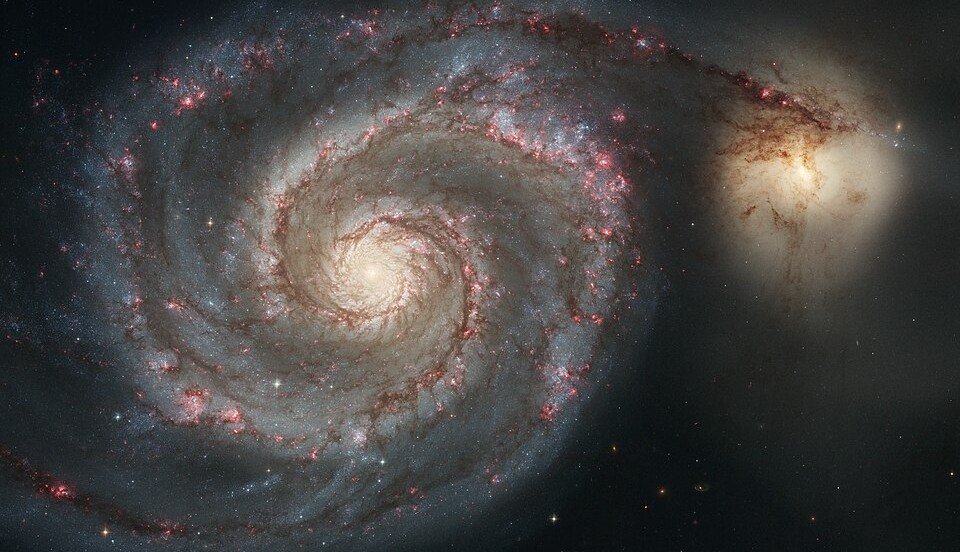
Whirlpool Galaxy M51
Whirlpool Galaxy M51 · NASA/ESA Hubble · Public Domain

Start over

Back to the beginning →

Home The Theory