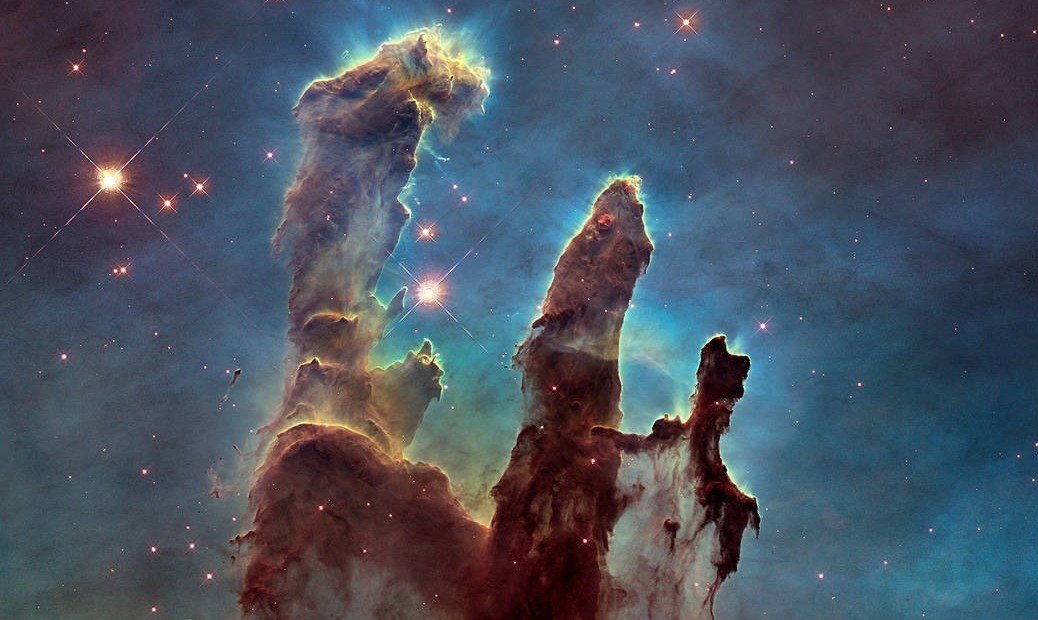
"The flow that causes ageing, growth, change — it is the flow of electromagnetic energy through matter."
Pillars of Creation (Eagle Nebula) · NASA/ESA Hubble · Public Domain
Einstein's equations are right. But are his explanations? Quantum Relativity keeps every result — and gives every one of them a physical mechanism for the first time.
Matter is made of electromagnetic energy — of light — circulating inside every particle at the speed of light.
This single premise, taken seriously and followed through mathematically, produces every relativistic effect we observe. Not as geometric axioms about the shape of the universe. As physical consequences of what matter actually is.
Grahame Blackwell published this work in two peer-reviewed papers in 2011. The mathematical constructs match relativity exactly. The explanations go further.
Relativity describes what happens with extraordinary precision. It does not explain why. Asserting that time dilation is "a feature of spacetime geometry" answers nothing mechanically — it is the scientific equivalent of invoking the divine.
Quantum Relativity offers a physical mechanism for every relativistic effect. Same equations. Real reasons.
"Matter tells space how to curve, and curved space tells matter how to move."
John Wheeler — a magnificent description. Not a mechanism.
Every particle is one or more self-sustaining loops of light at speed c. Experimentally confirmed by the Breit-Wheeler process and Schrödinger's Zitterbewegung.
Motion physically alters the observer's instruments — because they too are made of EM energy. Reality is single-valued. Observers in different states perceive it differently.
Every particle's field extends to infinity. The combined fields of all matter produce a field-density gradient. Objects directed by that gradient and associated attracting factor — that is gravity. No extra dimensions needed.
Why do moving clocks run slow? Relativity says: spacetime geometry. No mechanism given.
Why is light speed constant for every observer? Relativity says: it's a postulate. Take it on faith.
What is curved spacetime, physically? What extra dimension does it curve into? Silence.
Copenhagen: don't ask what's really happening. Just calculate. The mystery is irreducible.
British physicist, systems researcher, and the originator of Quantum Relativity.
Blackwell's path to Quantum Relativity began on Dartmoor — watching streams reshape landscapes and sensing that time behaved more like a flowing medium than a geometric dimension. In parallel, his work as a key player in an 8-partner EU research consortium on 3G mobile telecommunications deepened his understanding of electromagnetic energy and the unexplained features of Maxwell's equations.
The two threads converged. His two 2011 papers in the systems science journal Kybernetes — one on special relativity, one on gravitation — established the mathematical framework. Both are peer-reviewed. Both are publicly available.
"Relativity asserts that all sorts of things are so — but signally fails to offer any causal mechanism for those effects, beyond the catch-all that this is how the universe operates. Get used to it."
Grahame Blackwell"My take provides cogent explanations, in every case, of how it is that these things come to be so — with no weird counter-commonsense requirements."
Grahame BlackwellReady to go deeper?